
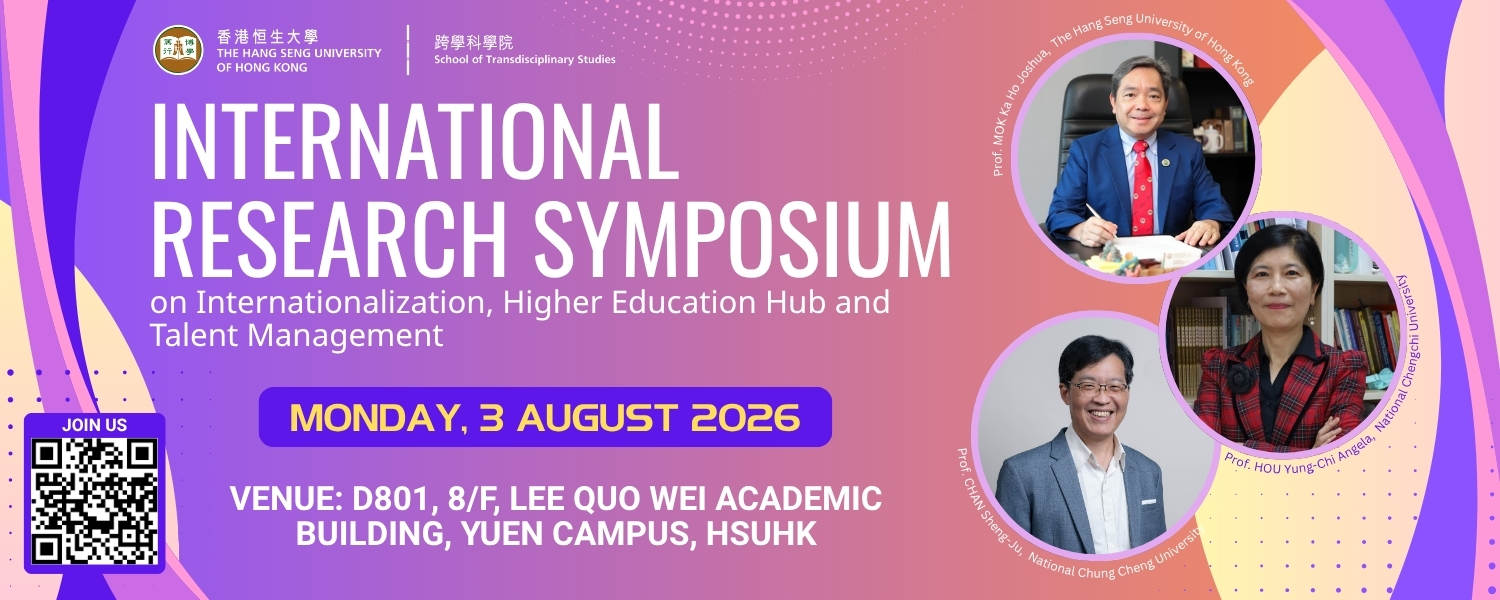
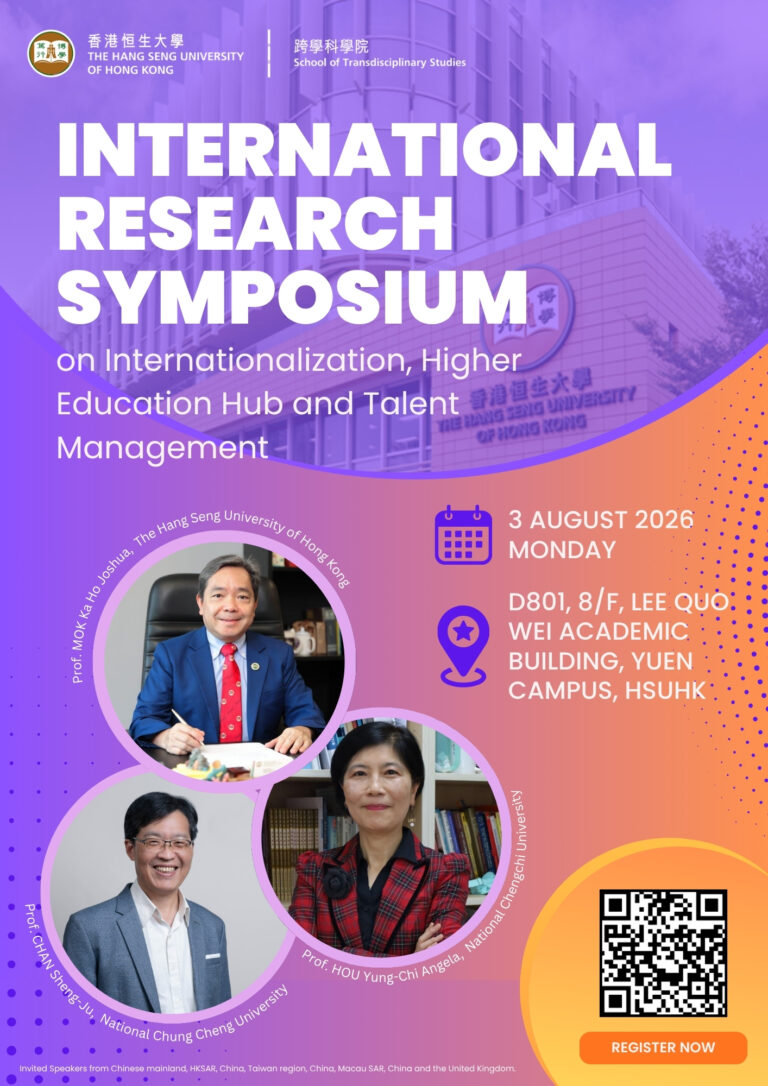
3 August 2026 (Monday)
D801 HSUHK & Online Via Zoom
09:30 - 16:30 (HKT)
The global landscape of higher education is undergoing profound transformation. Across Asia and beyond, universities are no longer viewed only as sites of teaching and research, but also as strategic engines of innovation, knowledge production, talent circulation, and regional development. As governments seek to strengthen competitiveness in the knowledge economy, the internationalization of higher education has become closely intertwined with the building of higher education hubs and the attraction, development, and retention of high-calibre talent.
The International Research Symposium on Internationalization, Higher Education Hub and Talent Management will be held on Monday, 3 August 2026, with participation available in hybrid mode. The symposium brings together scholars, policymakers, and practitioners to examine how higher education systems are responding to changing demands for internationalization, hub development, and talent attraction.
The symposium is informed by our ongoing Public Policy Research project on strategies to attract and retain high-calibre talents to pursue doctoral studies in Hong Kong, funded by the Public Policy Research Funding Scheme of the Government of the HKSAR. The project examines Hong Kong’s ambition to strengthen its role as an international higher education hub, while situating this ambition within a wider comparative context that includes other prominent education hubs such as Singapore, Malaysia, and the United Kingdom.
At the heart of this discussion is a critical policy question: how can higher education systems strengthen their capacity to attract and recruit high-calibre international talent, while also creating the conditions for these talents to thrive, contribute, and remain connected to the places in which they study and work? Addressing this question requires attention not only to institutional reputation and academic quality, but also to immigration pathways, doctoral funding, research infrastructure, career opportunities, housing, family support, industry collaboration, and the broader social conditions that shape students’ and researchers’ decisions.
By placing internationalization, higher education hub development, and talent management in conversation with one another, this symposium seeks to generate comparative insights and practical policy ideas for Hong Kong and the wider region. It invites participants to reflect on the evolving relationship between higher education and talent strategy, to learn from international experiences, and to consider how universities, governments, and society can work together to build more inclusive, competitive, and future-oriented higher education ecosystems.
We hope this symposium will serve not only as an academic exchange, but also as a constructive space for shaping policy-relevant conversations on the future of higher education, doctoral training, and talent development in an increasingly mobile and competitive world.
Hosted by
School of Transdisciplinary Studies, The Hang Seng University of Hong Kong
Funded by
The Public Policy Research Funding Scheme of The Government of the Hong Kong Special Administrative Region
Contact Us
Email: sts@hsu.edu.hk
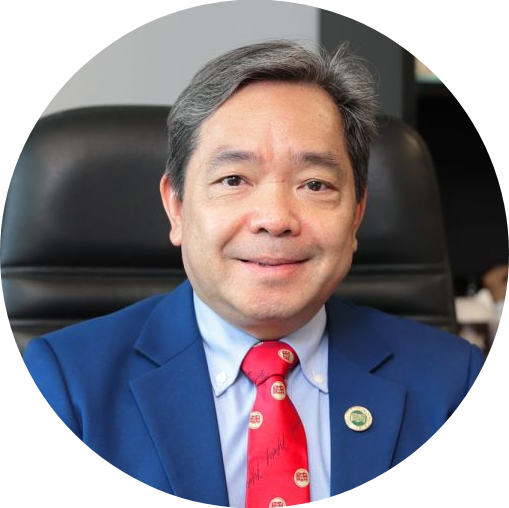
Prof. MOK Ka Ho, Joshua
The Hang Seng University of Hong Kong
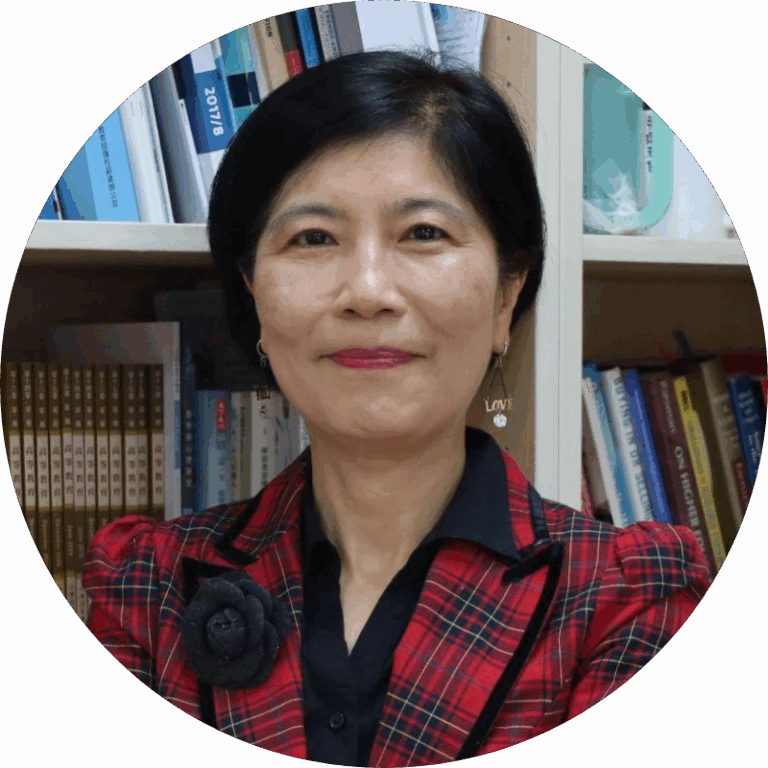
Prof. HOU Yung-Chi, Angela
National Chengchi University

Dr. WRIGHT Ewan
The Education University of Hong Kong
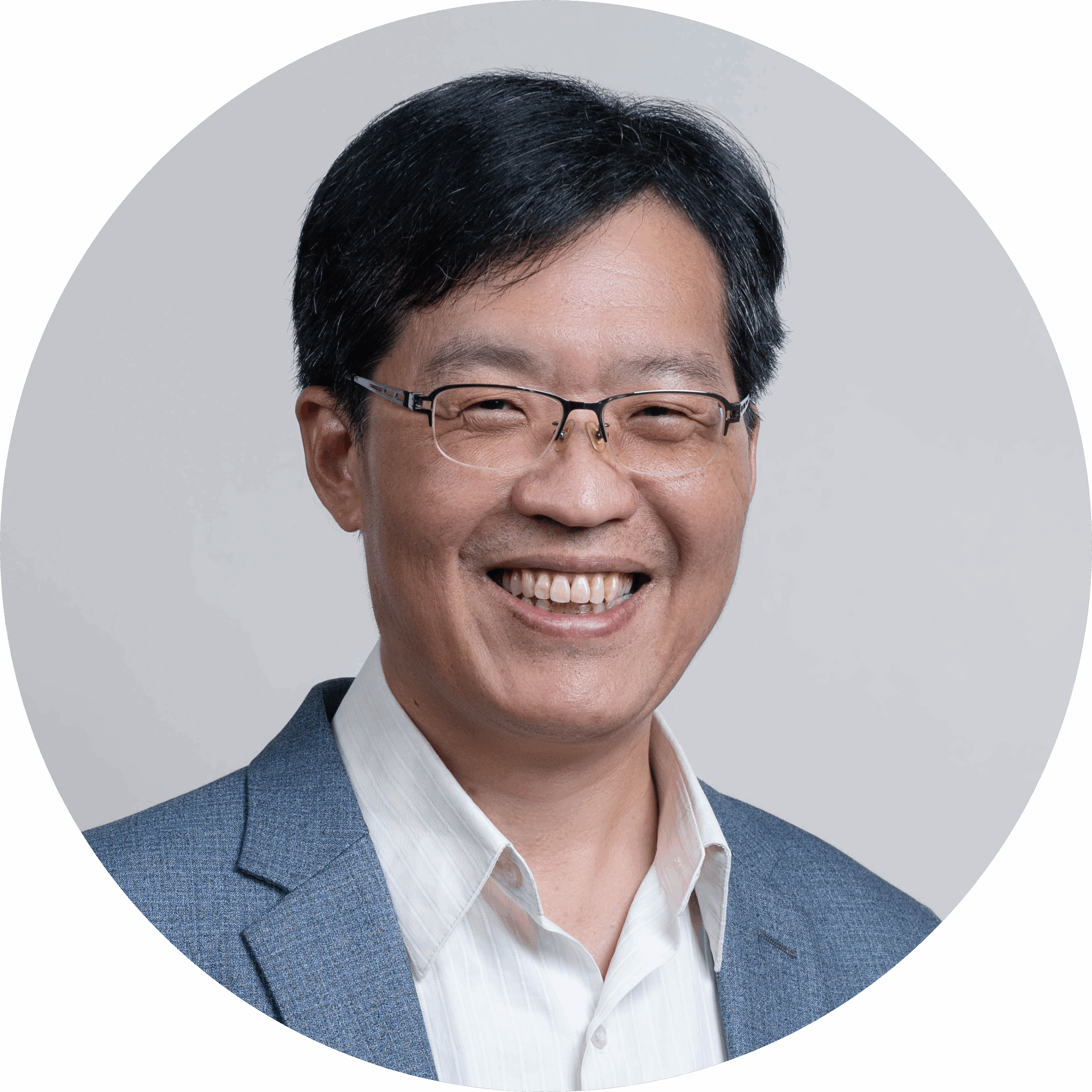
Prof. CHAN Sheng-Ju
National Chung Cheng University

Dr. XIONG Weiyan
The Education University of Hong Kong

Dr. OLADOSU Ayomide Oluwaseyi
The Hang Seng University of Hong Kong

Dr. KE Guoguo, Rainie
The Hang Seng University of Hong Kong

Prof. FRIGINAL Eric
The Hong Kong Polytechnic University

Ms. LI Xinrui
The Hong Kong Polytechnic University

Mr. RI Gwang
Peking University
[online]

Dr. ZHAI Keyu, Colin
The Hang Seng University of Hong Kong (will join us)

Prof. LO Yat Wai, William
Durham University
[online]

Ms. CAI Linghua, Echo
Durham University
[online]

Dr. TIAN Zhen, Jane
The Hong Kong Polytechnic University
Registration
Each registrant should complete a separate registration form. Email confirmation will be sent upon receipt of your registration. If you do not receive this confirmation within two weeks, please contact us at sts@hsu.edu.hk.
Registration Deadline
Please register by 23 July 2026 (Thursday).
Online via Zoom
Zoom Meeting ID: 999 9148 9200
Zoom Meeting Passcode: HSU202608
Session I
Presentation 1
Speaker: Prof. HOU Yung-Chi, Angela (National Chengchi University)
Topic: Beyond Excellence and Quality from world “classness” to SDGs engagement – Can Asia’s Top Universities serve as Catalysts driving system reform?
Abstract: Universities and academics have been increasingly encouraged to improve research performance, international visibility, and institutional reputation in order to achieve world-class standing. Existing research has consistently demonstrated a close relationship between world-class university development and national policy agendas, with higher education excellence initiatives serving as key policy instruments for strengthening institutional competitiveness and global standing. Concurrently, as sustainability has become a prominent global agenda, university rankings and quality assurance systems have introduced new assessment metrics to capture and evaluate higher education institutions’ engagement with, and contributions to, the Sustainable Development Goals (SDGs). These emerging SDG-related metrics aim to move beyond traditional evaluation frameworks in higher education. This presentation examines SDG engagement among the top 200 research universities in Asia and the challenges they encounter in integrating sustainability into institutional practices and evaluation systems.
Presentation 2
Speaker: Prof. MOK Ka Ho, Joshua (The Hang Seng University of Hong Kong)
Topic: The Quest for International Higher Education Hub in Hong Kong: Comparative Perspectives and University Governance
Abstract: Hong Kong is actively pursuing to become an international higher education hub in Asia. This presentation compares Hong Kong with other education hubs in Malaysia, Singapore and the United Kingdom in examining the similarities / differences of policies and strategies adopted to attract and retain global talents. The paper also highlights the uniqueness of Hong Kong and weaknesses when questing for becoming an international education and talent hub. Policy implications will be discussed for drawing comparative lessons from other hub projects.
Presentation 3
Speaker: Dr. WRIGHT Ewan (The Education University of Hong Kong)
Topic: Building a Higher Education Hub through Doctoral Talent: Insights from PhD Students in Hong Kong
Abstract: Hong Kong’s ambition to become a world-class higher education hub depends not only on the internationalisation of its universities, but also on how effectively it attracts, supports, and retains doctoral talent. This paper examines the Hong Kong PhD Fellowship Scheme (HKPFS), a flagship policy designed to recruit the “best and brightest” PhD students globally. The study draws on a survey of non-local HKPFS students (n = 253), followed by in-depth interviews with current students (n = 50) and graduates (n = 50) across eight publicly funded universities in Hong Kong.
The findings show that the HKPFS is a significant instrument of internationalisation and talent management. It attracts highly competitive PhD students from diverse national backgrounds, supports strong research productivity, and provides high-quality academic training in an internationally connected environment. For many participants, Hong Kong serves as a valuable platform for career development, especially across Asia.
The picture, though, is not uncomplicated. For many students, Hong Kong remains an underrated doctoral destination, still measured against the durable prestige of Anglo-American systems. Participants also describe uneven social integration and constrained opportunities for academic employment in Hong Kong after graduation.
Overall, the paper argues that a higher education hub succeeds not simply by recruiting talent, but by making talent visible, connected, and impactful over the longer-term. To support this process, key recommendations are presented aimed at building on the success of the HKPFS and its contribution to Hong Kong.
Session II
Presentation 4
Speaker: Prof. CHAN Sheng-Ju (National Chung Cheng University)
Topic: “Like Asking the Rock to Bleed”: Credential Conversion and the Structural Limits of Returnee Employability
Abstract: International credentials are widely assumed to enhance graduates’ employability upon return to their home countries. Yet less is known about why the same credential generates different employment outcomes across receiving contexts. This study traces the post-graduation trajectories of 21 alumni from the same master’s program at a public university in Taiwan across nine countries in Latin America, the Caribbean, and Southeast Asia. Since the credential, curriculum, and awarding institution are held constant, variations in employment outcomes can be examined in relation to receiving environments rather than differences in credential quality or program design. Drawing on Brown’s positional conflict theory and Bourdieu’s capital-field-habitus framework, the study uses reflexive thematic analysis of semi-structured interview data to identify five structural conditions shaping credential conversion: credential-market saturation, state-employment linkage, credential legibility, employment access regimes, and political conditions affecting knowledge use. The analysis further introduces the concept of credential illegibility, a form of conversion failure in which a credential is valued and recognized by employers and colleagues but cannot be processed within the bureaucratic format of the receiving institution. The findings demonstrate that the labour-market value of international credentials is not inherent in the credential itself but is structurally produced through the institutional, bureaucratic, and political conditions of the receiving environment.
Presentation 5
Speaker: Dr. XIONG Weiyan (The Education University of Hong Kong)
Topic: More Than “Cash Cows”: Re-examining Hong Kong Self-financed Taught Postgraduate Programs from a Lifelong Learning Perspective
Abstract: The Hong Kong higher education sector has experienced a profound and rapid expansion of self-financed taught postgraduate (TPg) programs over the past decade. These intensive one-year programs have substantially contributed to the financial sustainability and strategic growth of universities, enabling them to diversify their offerings and strengthen their institutional resilience. However, this rapid expansion has also raised concerns about the consistency and rigor of program quality, as well as students’ overall learning experiences. In this talk, I will examine the eight University Grants Committee (UGC)-funded universities, focusing on the quality assurance and development challenges faced in expanding their self-financed TPg programs. Drawing on my research with TPg students and faculty members, I will critically analyze current quality management practices and explore their effectiveness. Additionally, I will discuss the promising potential of self-financed TPg programs from a lifelong learning perspective, especially in light of the emerging trend of developing Chinese-medium instruction programs within some UGC-funded universities. When maintained with high standards of quality assurance, these programs can serve as vital avenues for providing accessible lifelong learning opportunities to non-traditional students from the Chinese mainland, thereby fostering greater educational inclusivity and enhancing Hong Kong’s status as a higher education hub.
Presentation 6
Speaker: Dr. ZHAI Keyu, Colin (The Hang Seng University of Hong Kong) (will join us)
Topic: Graduate Employability Paradox in the Greater Bay Area: An Empirical Study of STEM Master’s Students
Abstract: This study examines the STEM master’s employability paradox in the Greater Bay Area’s transnational higher education, in which promises of global prestige and curricula do not always translate into measurable job outcomes, creating tension between long-term capability development and short-term institutional metrics like placement rates. Using a quantitative design comparing a Hong Kong university, its mainland branch, and a joint institute, the study treats institutional context as the independent variable, employability preparedness as dependent, and resource exposure as a mediator, while also considering degree signalling and value-for-money perceptions. Drawing on employability theory, performance-based governance, and transnational education frameworks, the research collected data from 250-300 senior students via online questionnaire and analysed data using SPSS with ANOVA, regression, and PROCESS Macro mediation. The study aims to empirically demonstrate how preparedness profiles differ across settings and conceptually challenge the assumption that institutional branding alone guarantees advantage, arguing that concrete resources, not just reputation, drive employability, while critically questioning whether transnational education automatically justifies its cost, ultimately framing the paradox as both a student concern and a governance problem within the GBA.
Session III
Presentation 7
Speakers: Prof. FRIGINAL Eric & Ms. LI Xinrui (The Hong Kong Polytechnic University)
Topic: Sustaining Hong Kong’s Higher Education Hub: Global Academic Mobility, Mainland Chinese Academics, and Talent Integration
Abstract: Hong Kong SAR offers an important case for examining academic mobility, internationalisation, and talent management in a global higher education hub. Although its higher education system is relatively small, its major universities are highly internationalised and employ an exceptionally large proportion of non-local academics. Mainland Chinese scholars have become the largest non-local academic group and have recently outnumbered local academics (Li & Friginal, 2026). Their growing presence provides a valuable lens through which to understand changing academic labour patterns, institutional governance, and talent development in Hong Kong higher education.
Drawing on career capital theory, this presentation examines the features, opportunities, and challenges of mainland Chinese academics in eight University Grants Committee-funded universities. Methodologically, the present research employs document analysis to trace how career capital is accumulated, transferred, and institutionally positioned through the dimensions of knowing-why, knowing-how, and knowing-whom. As part of a wider study, the analysis draws on academic staff headcount data, information on 979 academics holding leadership roles, and the academic trajectories of 363 mainland Chinese scholars.
The findings indicate that mainland Chinese academics possess substantial global career capital and are increasingly prominent in Business and STEM-related fields. They are more institutionally included than other non-local academics and are particularly visible in research and innovation-related leadership. Yet their career development remains unevenly shaped by institutional structures, leadership opportunities, and the continuing advantages associated with locally nurtured academic talent. This study argues that Hong Kong’s competitiveness as an international higher education hub depends not merely on attracting globally mobile scholars, but on its capacity to foster their long-term academic integration, recognise diverse forms of career capital, and translate international mobility into sustainable institutional and scholarly development.
Presentation 8
Speaker: Mr. RI Gwang (Peking University) [online]
Topic: Doctoral Capital and Career Development Choices in South Korea: A Comparative Study of Chinese International and Korean Domestic PhD Students
Abstract: This study examines doctoral career development in South Korea in the context of higher education internationalization, regional education hubs, and talent management. As South Korea seeks to strengthen its position as a regional higher education hub, doctoral students are not only learners within university systems but also emerging knowledge workers whose career trajectories are closely related to the sustainability of talent development. Drawing on a longitudinal qualitative study of Chinese international doctoral students in South Korea, supplemented by interviews with Korean domestic doctoral students, this study compares how the two groups understand the value of doctoral capital and the stability of career opportunities within the same higher education and labour-market environment. Doctoral capital refers to the academic training, research outputs, supervisor networks, institutional reputation, language skills, professional experience, and symbolic recognition accumulated during doctoral study. The findings suggest that both groups are concerned with whether doctoral training can be converted into stable and recognizable career opportunities, but the mechanisms shaping their choices differ. For Chinese international doctoral students, career choices are shaped by the cross-border convertibility of Korean doctoral capital, visa status, language barriers, local networks, and opportunities in both Chinese and Korean labour markets. For Korean domestic doctoral students, career choices are more closely related to the structure of the Korean academic labour market, postdoctoral opportunities, institutional competition, and the relative attractiveness of academic and non-academic pathways. The study argues that a higher education hub should be assessed not only by its capacity to attract doctoral students, but also by whether it can provide sustainable career futures for both international and domestic doctoral talent.
Presentation 9
Speakers: Dr. OLADOSU Ayomide Oluwaseyi & Dr. KE Guoguo, Rainie (The Hang Seng University of Hong Kong)
Topic: Competing for Global Doctoral Talent: Policy Strategies, Opportunities, and Challenges in Hong Kong, Singapore, and Malaysia
Abstract: As international student mobility continues to expand, doctoral students have emerged as a strategic talent group central to research, innovation, and national competitiveness. This study examines how Hong Kong, Singapore, and Malaysia compete to attract and retain international doctoral talent through different combinations of funding schemes, immigration policies, research capacity, and talent development strategies. The study adopts a mixed-methods approach, combining comparative policy analysis, interviews with international doctoral students, and survey data to explore the factors shaping doctoral students’ destination choices and post-graduation mobility intentions. Guided by Push-Pull Theory, Human Capital Theory, and the multipolar higher education perspective, the study investigates both structural and individual-level determinants of doctoral mobility.
Findings show that scholarships and financial support, employment prospects, immigration pathways, academic reputation, and political stability are among the most influential factors affecting destination choice, while financial difficulties, career uncertainty, and visa-related concerns remain key challenges. Comparative analysis reveals that Hong Kong benefits from generous doctoral funding and flexible post-study immigration pathways, Singapore leverages research excellence and industry linkages, while Malaysia draws strength from affordability and regional accessibility. However, all three hubs face challenges in converting doctoral recruitment into long-term talent retention. The study highlights the need for integrated policy approaches that align higher education, immigration, research, and talent strategies to strengthen competitiveness in the global race for doctoral talent.
Session IV
Presentation 10
Speakers: Prof. LO Yat Wai, William & Ms. CAI Linghua, Echo (Durham University) [online]
Topic: Why Do Chinese Students Choose Chinese Studies in UK Universities? Subject Choices and Career Prospects
Abstract: Chinese Studies has traditionally been regarded as the academic study of China, largely developed by scholars outside China for international audiences. In recent decades, however, an increasing number of Chinese students have enrolled in Chinese Studies courses at UK universities. This study examines why these students choose to take China-related courses abroad and how these choices relate to career prospects. Employing an ethnographic and longitudinal design, the study draws on six months of fieldwork in two Chinese Studies modules, one postgraduate and one undergraduate. Data were collected through participant observation, fieldnotes, document analysis, and interviews with 21 participants, each followed by a second-round interview after six months. Informed by Collins’ credentialism and Bourdieu’s concept of symbolic capital, the study reveals that Chinese students strategically mobilise familiar cultural knowledge in a foreign academic context to acquire internationally recognised credentials. Their subject choice, however, is less about alignment with specific career plans than about the symbolic value of the degree and the prestige of the awarding university, both of which are seen as crucial markers in China’s competitive job market. The study highlights the interplay between global education markets and local employment structures, showing how international higher education perpetuates credentialist logics and intensifies the “credential arms race” in the labour market.