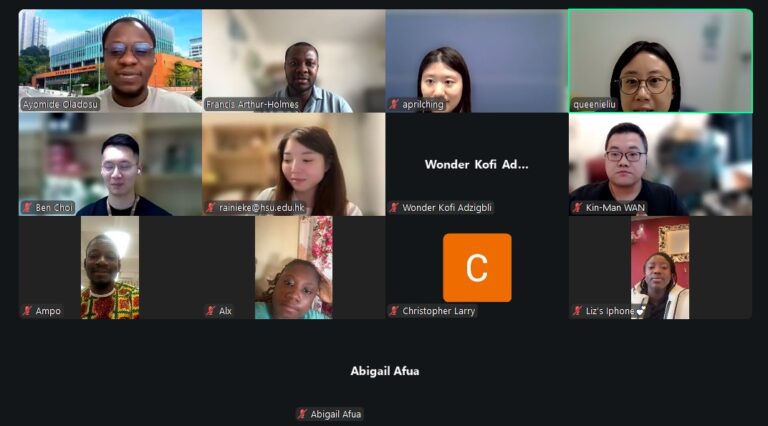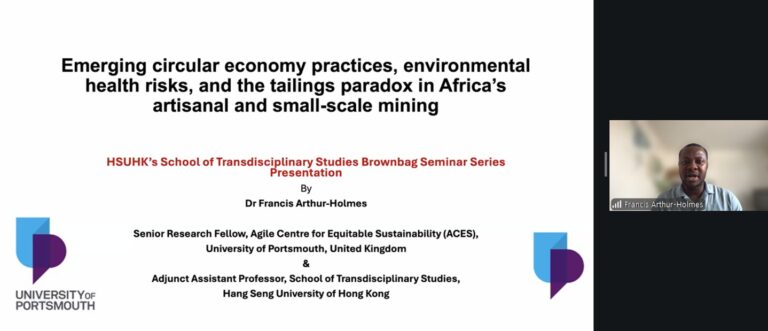
The School of Transdisciplinary Studies (STS) at The Hang Seng University of Hong Kong (HSUHK) held the second session of its STS Brownbag Seminar Series on Friday, 10 April 2026, featuring a presentation by Dr. Francis Arthur-Holmes on the environmental and health risks associated with emerging circular economy practices in Africa’s artisanal and small-scale mining (ASM) sector.
Delivered online, the seminar attracted faculty members, researchers, and students from HSUHK, Ghana, and Europe for an engaging discussion on how sustainability‑oriented innovations in informal mining can generate both benefits and unintended harms. Dr. Arthur-Holmes’ talk drew on empirical research conducted in Ghana, where artisanal and small-scale gold mining plays a significant role in local livelihoods while posing major environmental and public health challenges.
Central to the presentation was the concept of the “tailings paradox.” Dr. Arthur-Holmes explained that circular economy practices such as recycling and reprocessing mining waste – particularly tailings – can create socio-economic opportunities, including income diversification, youth employment, community cohesion, and disaster prevention. At the same time, these practices may intensify environmental pollution, increase exposure to toxic chemicals, and heighten health risks, especially for vulnerable groups such as children.
The seminar also examined how these contradictory outcomes are shaped by governance tensions in the ASM sector. Dr. Arthur-Holmes highlighted the complex interaction between formal and informal regulatory systems, noting that environmental interventions, while necessary, can inadvertently limit access to economic opportunities if local realities are overlooked.
During the Q&A session, participants discussed policy implications and possible pathways for balancing environmental protection with livelihood needs. Suggested approaches included collaborative governance frameworks, community-led monitoring, and the adoption of mercury-free processing technologies.
Overall, the session exemplified the objectives of the STS Brownbag Seminar Series by providing a relaxed platform for sharing research and fostering interdisciplinary dialogue on pressing global environmental and development challenges.